
E-commerce Architecture & WPO
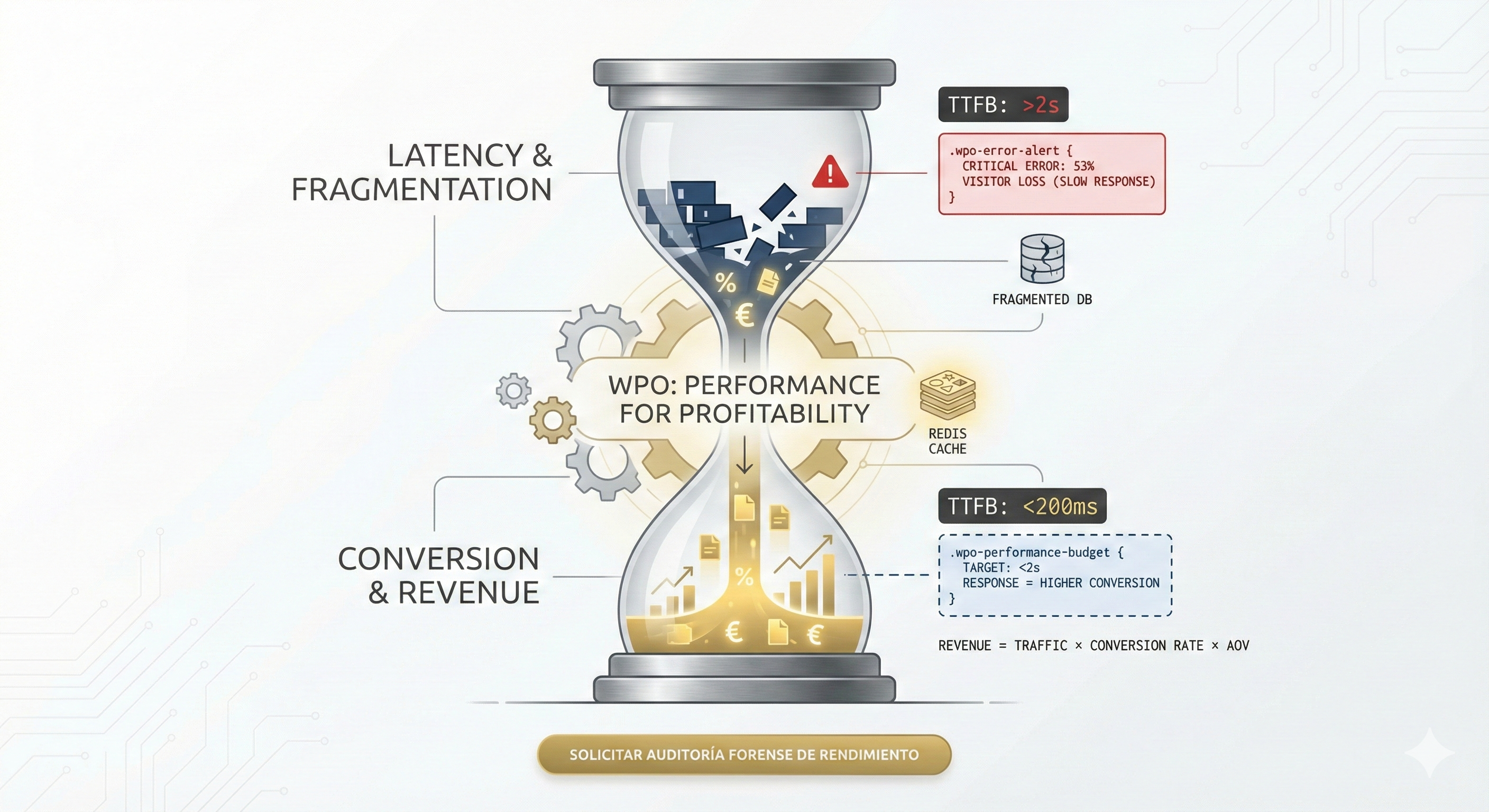
Performance Engineering (WPO) for WooCommerce. We optimize database and server to achieve loads under 1 second. If your store is slow, your competition wins.

Technical SEO Silo Architecture is the only vertical organization system that prevents your website from becoming a digital dump where search engines cannot assign thematic authority. Most online projects fail not because of the quality of their writing, but because of the absence of a defined pillar hierarchy. Without this engineering, your website is a disorganized warehouse where authority dissipates and the crawl budget is wasted on irrelevant URLs. Lacking a well-defined silo structure is guaranteeing that Google ignores your value proposition and that your SEO positioning is invisible in the SERPs. We are not talking about aesthetics or superficial content marketing: we are talking about digital survival.
Google has stopped tracking simple keywords; it now processes relevance vectors and semantic entities. If your website lacks a solid silo structure, you send conflicting signals to the algorithm. A site that mixes concepts without order is algorithmic noise for search engines, preventing you from positioning yourself as a thematic authority. Without a strict vertical organization that connects each pillar page with its secondary pages, your competition will devour you in every search result. This way of organizing content is not optional: it is the foundation of any competitive ranking strategy.
The most common mistake is allowing a “flat structure” where all content is one click away, diluting semantic relevance. It is imperative to implement strict Topic Clusters where each topic has a pillar page that organizes the main categories. It is also critical to understand that a poor pyramidal structure increases the click depth needed to find valuable content, which is suicide for ranking in search engines. For example, if you sell sports shoes and have articles on running, trail, and fitness mixed without hierarchy, Google does not know which is your main page for each topic.
Your investment in social media management is money burned if that content lands on a website without a defined silo structure. What’s the use of attracting users if the organization does not retain or distribute that authority? First, you must create an internal link structure that distributes Link Juice from the pillar page to all pages in the cluster. Social media management, video marketing, and social media only work as amplifiers when the foundations are solid. First repair the base, then invest in dissemination.

Let’s talk about money and server efficiency. Googlebot does not have infinite resources for your website. Every time the bot enters your domain, it allocates a crawl budget. If you don’t have a vertical silo structure, the bot gets lost crawling empty tags, duplicate URL parameters, and low-quality content. You are paying for content that Google will never index correctly. It’s that simple and that devastating.
CRAWL BUDGET LOSS FORMULA:
Total URLs: 500 | URLs in Vertical Silos: 120 | Orphaned URLs: 380
Crawl Efficiency = (URLs in Silos / Total URLs) × 100
Efficiency = (120 / 500) × 100 = 24%
RESULT: 76% of your crawl budget is burned on pages without vertical internal linking. Every wasted resource is a ranking opportunity you give away to your competition.
An orphaned URL – a page with no incoming internal links – is a digital corpse. By not belonging to any vertical cluster, it receives no internal PageRank (Link Juice). The result is devastating: articles on which you spent hundreds of euros on writing are left floating in limbo, unable to rank because your system does not transfer authority to them. Implementing a silo structure solves this through strict and vertical internal linking where each secondary page must link to its corresponding pillar page. SEO tools like Screaming Frog or Google Analytics can help check what percentage of your URLs are orphaned.
Link Juice Sculpting is the discipline within relevance engineering that determines how authority flows through internal links. In a correctly implemented silo structure, the homepage transfers authority to the main categories (first-level pillar pages). These, in turn, distribute Link Juice to second-level secondary pages. Finally, third-level articles and sheets inject thematic relevance upwards through strategic internal links, creating a positive feedback loop.
AUTHORITY FLOW IN A VERTICAL SILO STRUCTURE:
[HOME] → PageRank distributed to Pillar Pages (Level 1)
[PILLAR PAGE A] → Vertically links to Secondary Pages (Level 2)
[SECONDARY PAGES] → Link to Support Articles (Level 3)
[LEVEL 3 ARTICLES] → Return Link Juice to the Pillar Page →
RULE: Pages in one silo should NEVER horizontally link to pages in a different silo without going through the Home or an intermediate pillar page.
This type of vertical flow is what differentiates a website that ranks from a website that simply exists. If your third-level pages chaotically link to any other page without respecting the hierarchy, you are diluting the thematic authority that you worked so hard to build. The logical way to organize content is to create closed silos where each internal link has semantic meaning. You should also check with SEO tools that external backlinks point to the correct pillar pages to maximize the effect.

Without a vertical silo structure, it is mathematically inevitable that you will suffer from keyword cannibalization. This happens when multiple pages on your site compete for the same search intent. Google, not understanding which is the pillar or authoritative page due to the lack of hierarchy, decides not to rank any, or worse, alternates the URLs in the SERPs, destroying your CTR and your ranking.
A correct keyword research must be mapped directly to the silo structure. It is not enough to find search volume; you must assign each term to a specific depth level within the cluster:
If your website has 10 pages competing for the same main keyword, and each one cost €150 in professional writing, you have invested €1,500 in content that self-destructs. In other words, without a silo structure that assigns each keyword to a specific URL, your content marketing investment has a negative ROI. Cannibalization also affects your local SEO if different content on your website points to the same geolocated intent.
With the arrival of SGE (Search Generative Experience) and LLMs integrated into search, ambiguity is severely punished. Artificial intelligence understands relationships between entities in a vectorial way. If your content on “sports shoes” is chaotically mixed with “cooking recipes” without logical separation into main categories, the AI cannot vectorize your site as an expert source on either topic. This is something you can see directly reflected in your ranking positions.
The silo structure functions as a knowledge schema for machines. It tells the engine: “Everything under this directory belongs to entity X and has a semantic relationship with entity Y”. Without this, you are invisible to the new generation of search engines. LLMs like ChatGPT, Gemini, and Google’s AI Overviews process thematic authority by evaluating the semantic density of each cluster. If your pillar pages are not vertically connected with their related content, the model cannot build a consistent relevance vector for your domain.

Language models do not “read” your website like a human. They process tokens and calculate embeddings. A vertical silo structure allows the embedding of your pillar page to be semantically close to the embeddings of its secondary pages and third-level articles. This creates what in data science is called a “dense cluster” in the vector space. A flat website, on the other hand, generates scattered vectors that no model can interpret as authority. Creating such a structure not only helps with classic SEO but also prepares your website to dominate in results generated by artificial intelligence.
Analyzing performance data, the advantages of implementing this engineering are clear and measurable in any serious SEO audit:
Performing an SEO audit is the first step to stop the bleeding. You must check your robots.txt file, your XML sitemap, and, above all, your URL structure. If your URLs look like domain.com/article-543 instead of domain.com/service/category/detail, you are failing in basic organization. SEO tools like Screaming Frog, Ahrefs, or Google Analytics are an essential tool to diagnose these problems. You can also see in Google Search Console which pages have the fewest incoming internal links.
The keyword research you did at the beginning of the project must be reviewed. Are the current keywords aligned with your directories and your pillar pages? Does each main keyword have a unique URL assigned within its silo? If the answer is no, you need an urgent URL restructuring with surgical 301 redirects to avoid losing historical authority. An updated SEO keyword research is the starting point to create a new silo structure that makes sense.

To illustrate the impact, consider this real example: a digital marketing services website with 200 URLs without a clear hierarchy. After implementing a silo structure in 4 phases, the results were drastic.
/silo/category/article. 301 redirects were implemented surgically to preserve existing backlinks. The homepage was redesigned to link exclusively to the 6 pillar pages. This type of result is not exceptional: it is the direct consequence of organizing content vertically. The technical debt from lacking adequate organization is the greatest silent enemy of your online business. From a web design point of view, organization by silos allows the project to scale sustainably: you can add subcategories or related pages without breaking the visual or logical hierarchy. The silo structure in SEO is, ultimately, the only way to organize content that search engines reward with visibility.
If your competition already structures its website in clusters with optimized internal links and well-defined pillar pages, each day without this configuration is another day of loss of authority and money. No matter how much you invest in social media management, content marketing, video marketing, or local SEO: without the foundation of a silo structure, it is all built on sand.
Is your web structure a map of authority or a toxic maze of irrelevant content?
Do not let a poor Technical SEO Silo Architecture continue draining your crawl budget, your ranking, and your conversions. Every day without a vertical silo structure is a day where your competition accumulates the thematic authority that you lose.