E-commerce Architecture & WPO
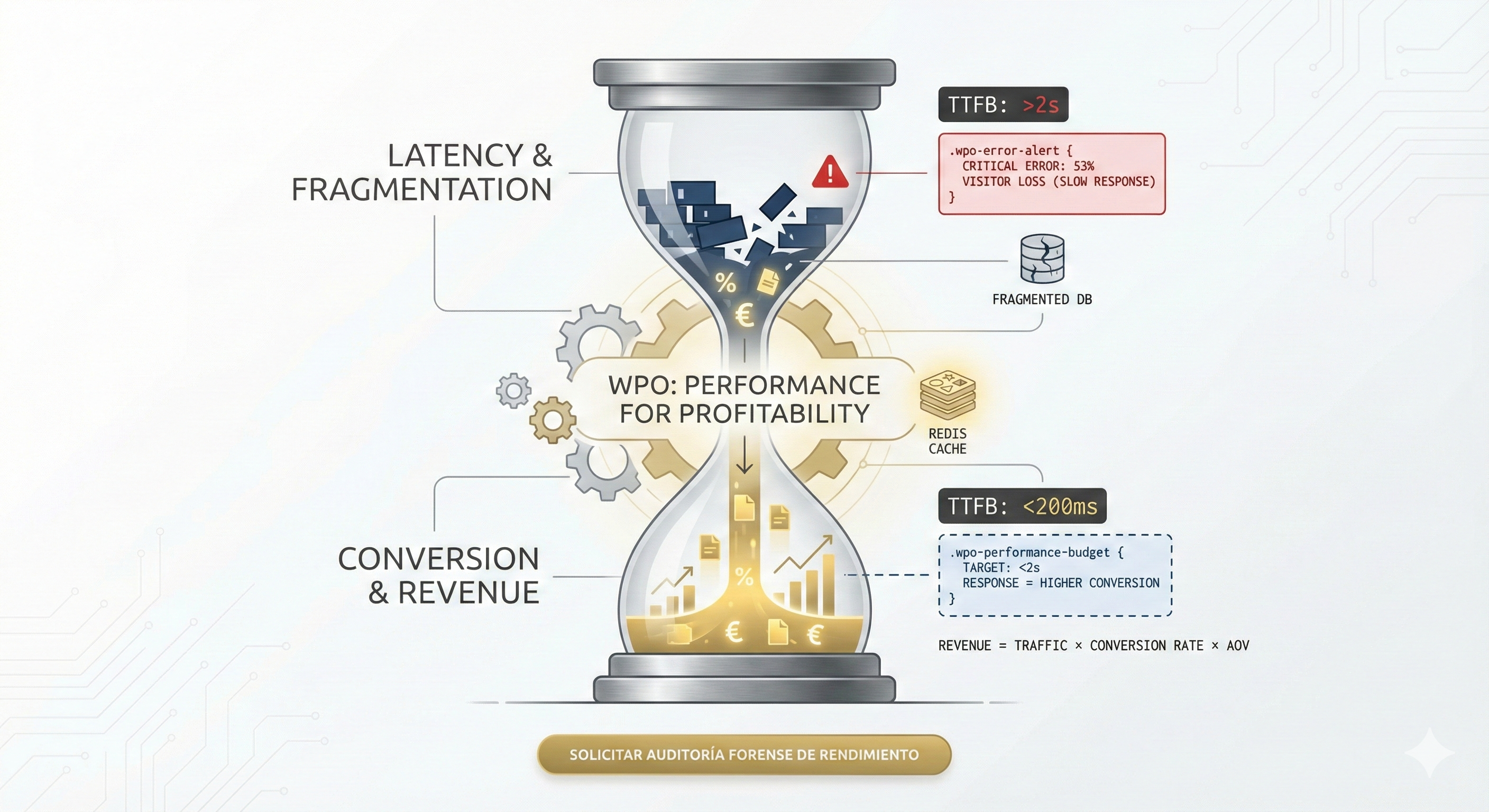
Performance Engineering (WPO) for WooCommerce. We optimize database and server to achieve loads under 1 second. If your store is slow, your competition wins.
Suffering a critical loss of visibility is not a coincidence, it is technical negligence. When a business’s organic traffic plummets after a core update, most look for quick fixes that don’t work. At WordPry, we understand that Google traffic drop recovery requires a scientific protocol. A critical drop in positions is a symptom of an unresolved root diagnosis, whether due to a manual penalty, algorithmic devaluation, or a low-quality content strategy.
The first step is to understand that recovering lost traffic is not achieved with cosmetic patches. Many websites that have suffered penalties continue to apply tactics that are no longer effective. To achieve a true Google traffic drop recovery, the user must find the real cause of the collapse and design a plan based on data, ensuring that their website is relevant to the search intent.

Before acting, you need a precise diagnosis. The search engine detects signals that most do not monitor: crawl frequency, rendering errors, and indexing problems. If you don’t know why your visibility decreased, you cannot design an effective strategy. The essential tools for this analysis are Google Search Console and Analytics.
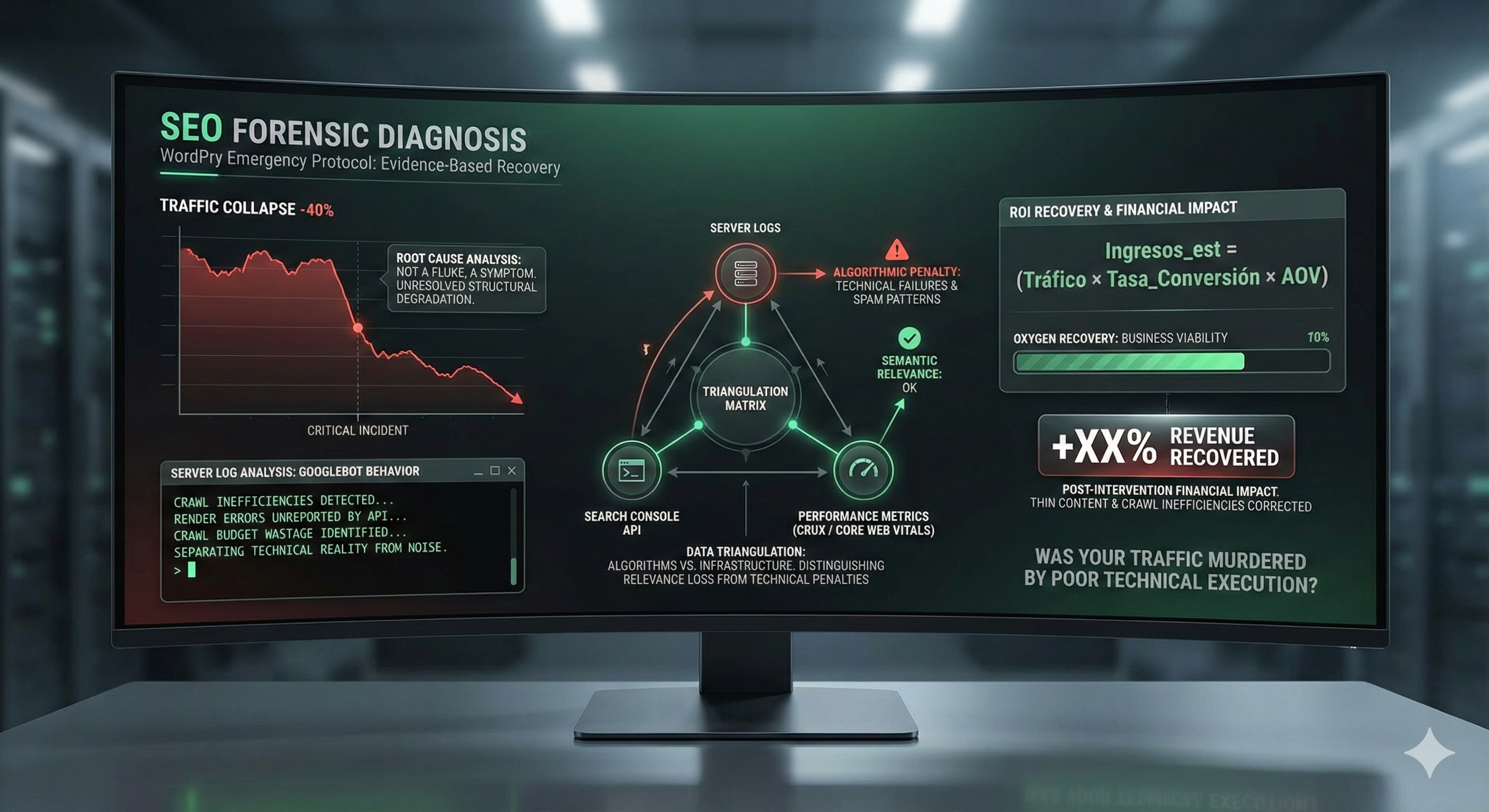
Relying exclusively on the basic Search Console interface is a mistake that prevents recovering lost traffic. To understand the problem, it is mandatory to use server log analysis tools. Only then can we see the real behavior of Googlebot and detect errors that affect your pages and that aggregated reports hide.
Analytics is also essential. Through the acquisition channels, you can see which sources are compensating for the loss. If organic traffic fell but direct traffic remains, the cause is specific to search results. Analyze behavior to detect if users are abandoning sections of the website that previously worked well.
You must analyze whether the search engine has stopped processing your content due to your CMS failures, server response times, or duplication problems. The most common technical errors include 5xx responses, redirect loops, and JavaScript failures. This is the only way to ensure that URLs are re-indexed correctly and to improve technical quality.
Visibility is also affected when broken links cut the flow of authority. Reviewing internal linking is as important as auditing the text, because without a solid architecture, the search engine cannot discover or value the information on each page. Good technical work ensures that crawling is always efficient.

Recovery after an algorithm update requires precise triangulation. The goal is to differentiate whether we are facing a loss of semantic relevance or a penalty. Not all drops are the same: an update can reward the competition without directly penalizing you, which requires improving your content substantially.
Sometimes, the problem is not the site, but toxic links. The algorithm purges domains with artificial profiles. Check if you have ever bought reviews or if there is spam pointing to your domain. Verify your backlinks with professional tools and analyze if your profile seems natural.
Many websites have suffered penalties for not auditing their references in time. If your links were sanctioned, the path to recover lost traffic goes through a disavow process combined with generating natural mentions from high-authority sources.
Diversifying with social networks and platforms like YouTube and LinkedIn also helps. These channels provide visits and social signals that reinforce the domain’s authority in the face of a possible Google traffic drop recovery.
Ignoring technical health during a visibility crisis is dangerous. User experience is decisive: slow loading times and poor interactivity penalize ranking. Core Web Vitals (LCP, FID, CLS) must be optimized to avoid drops and improve positioning in search results.
Stability must be sustained by optimization of CrUX metrics and Core Web Vitals, ensuring that the website is not affected again by poor speed. Improve navigation and optimize images so that users have a smooth loading experience.
/* Panel de Diagnóstico Forense de Incidencias en Google */
.seo-forensic-emergency { background: #000000 !important; color: #00ff00 !important; border: 3px solid #ff0000 !important; padding: 25px !important; font-family: 'Courier New', Courier, monospace !important; margin: 20px 0 !important; display: block !important; width: 100% !important; box-shadow: 0 0 15px rgba(255, 0, 0, 0.5) !important;
}
.seo-recovery-stat { font-size: 1.5rem !important; font-weight: 900 !important; color: #ffffff !important; text-shadow: 2px 2px #ff0000 !important; display: inline-block !important;
}To increase click-through rates (CTR) and visibility, it is vital to redo the information architecture. The search engine penalizes ambiguity and rewards depth. Outdated material is a real cause of collapse in many projects that do not update their articles, affecting overall quality.
Audit your keywords and avoid cannibalization. A solid plan involves considering these important elements:
Artificial intelligence is changing the rules. The search engine does not prohibit the use of AI, but it does penalize text that lacks value, regardless of its origin. You can use AI as support, but human supervision is still necessary to provide useful, unique, and good quality information.

If your business depends on location, local SEO can also be affected. Specific signals are used such as the Business Profile listing and reviews. Local services must be integrated into the global recovery. Businesses that neglect this aspect lose important opportunities by not being present in searches in their area.
Updates are cyclical. What works today may be penalized tomorrow if relevance is not maintained. Use professional tools to monitor changes daily and identify early signals before another web traffic drop occurs. Assign a responsible person and set up alerts.
Good optimization work is continuous. Websites that manage to maintain stable positions are those that review metrics, update their content, and always adapt the structure to algorithm changes. Reviewing performance reports must be routine.
Discover generates thousands of daily visits to sites that meet its criteria. It shows content without an explicit query, being a passive channel. To capture this traffic, you need optimized images, curious titles, and frequent updates.
It is key to understand that E-E-A-T (Experience, Expertise, Authoritativeness, and Trustworthiness) is favored. Publish formats like news and updated guides. If you have lost presence in traditional results, Discover can be the means to recover lost traffic while you optimize the rest.
Relying only on one channel is a risk. YouTube, LinkedIn, and Instagram provide diversification. Creating material adapted to each medium reduces vulnerability. An article can be reformatted as a video, multiplying the reach and visibility of your brand.
Digital marketing demands presence on several fronts. The digital kit can finance this diversification, allowing investment in professional audits without compromising the budget.

Recovering positions requires order. After identifying the origin, the intervention follows this protocol:
This process includes constant monitoring. Domains that implement this protocol manage to restore organic traffic within 3 to 6 months, depending on the severity of the situation.
A forensic intervention is measured in financial recovery. We use this formula to quantify the oxygen the business recovers after correcting inefficiencies and problems that were hindering growth:
This formula allows seeing the cost of not acting. Low visibility directly impacts revenue. A timely audit avoids greater losses. Forensic recovery services remove penalties and restore positions sustainably and safely.
Do not wait for the next update to finish sinking your business. Every day counts. If you have lost traffic due to technical errors, poor content, or a penalty, forensic intervention is the path to Google traffic drop recovery and protecting your investment.
Has your organic traffic dropped or has it been affected by poor execution?